Human Rights Management
Performance Goals
| Topics |
Performance | Goal | ||
| 2023 | 2024 | 2024 | 2027 | |
| Number of times training employees on human rights and labor | 20 | 36 | - | - |
| Proportion of coverage of PTG and its subsidiaries receiving training on human rights and labor | 33.33% | 98.41% | 80% | 100% |
| Statistics on cases in which the company has been complained of or sued for violating human rights | 0 | 0 | 0 | 0 |
Human Rights Due Diligence
PTG is committed to conducting business with responsibility by adhering to the principles of transparent, verifiable, ethical business practices, respect for human rights and equitable treatment of all groups of stakeholders in order to support the implementation of human rights principles and participate in the management of human rights impacts that potentially occur throughout the business value chain. The Company has developed a comprehensive human rights due diligence process to deal with the risks of human rights issues and promote a culture of respect for human rights within the organization. The Company's comprehensive human rights due diligence process consists of the following steps:
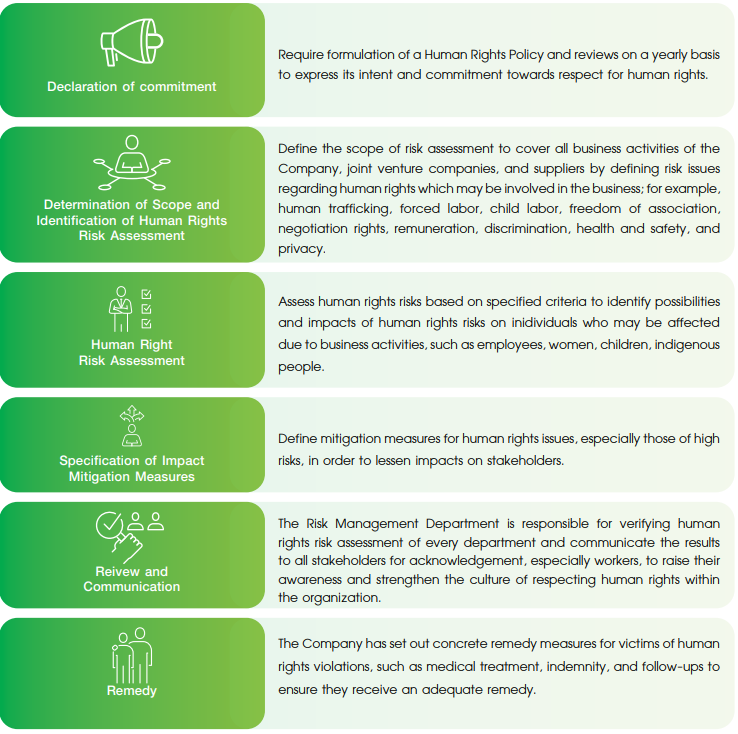
Human Rights Policy
PTG has established a human rights policy by adhering to and complying with the human rights policy in conducting business in accordance with labor laws and related laws. The principles of the United Nations Universal Declaration of Human Rights (UDHR), the United Nation Global Compact (UNGC), and the United Nations Guiding Principles on Business and Human Rights (UNGP) have been adapted to suit the business context, which has specified guidelines for employees to promote a culture of respect for human rights both inside and outside the organization. This covers employees' rights, suppliers' rights, customers' rights, and community and environment rights. It is expected that subsidiaries, associated companies and joint ventures and business partners shall comply with the Company's human rights policy. This includes clear communication with all stakeholders, such as employees, communities, business partners, and affiliates. The company focuses on key human rights issues, including the prevention of discrimination, sexual harassment, child labor, and forced labor. These measures are taken to ensure that all sectors strictly adhere to international standards and relevant legal requirements.
Roles and Responsibilities
Board of Directors
Corporate Governance and Sustainability Committee
This committee is responsible for reviewing and endorsing the Human Rights Policy, providing guidance, and ensuring that the company’s operations comply with the human rights policy. The committee acknowledges progress and promotes actions that support respect for human rights, as well as other duties related to human rights in alignment with its charter. Additionally, the committee acknowledges reports of human rights violations submitted through the company’s reporting channels.
Enterprise Risk Management Working Group
Chief Financial and Sustainability Officer
Risk Management Department and Sustainability Development Department
- Develop and continuously review procedures for assessing human rights risks and impacts to ensure the approach remains up to date and effective.
- Monitor and verify the implementation of human rights risk and impact assessment procedures by relevant departments to ensure efficiency such as identifying human rights issues, implementing mitigation measures, and reducing levels of risk and impact.
Departments Involved in the Human Rights Risk Assessment Process
Departments responsible for human resources, safety and environment, procurement, sales, logistics, operations, marketing and customer relations, and supply chain management, among others, play the following roles:
- Identify human rights issues and potential impacts related to their operations.
- Establish control measures and mitigation actions to address identified impacts.
- Review human rights risk assessment results annually in accordance with the assessment procedures.
- Regularly review and update relevant documents to ensure accuracy and timeliness.
In addition, the company assigns management-level employees with knowledge and expertise in human rights to oversee daily operations to prevent potential human rights violations in PTG’s business activities, including business dealings with partners such as the Human Resources Department, Safety and Environment Department, and Legal Department.
Download Human Rights Policy

Lodgment of Human Rights Complaints
PTG empowers its employees and stakeholders to express their opinions that reflect problems, to report suspected activities, or to lodge complaints, if there is any activity or action that involves violations of human rights or codes of conduct arises, through whistleblower channels, including whistleblower@pt.co.th, call center, and mobile application, with proper and fair management of such complaints in place. Informants and complainants of human rights violations that are associated with Company's business shall be protected using the highest standards of protective measures.
Remedial Mechanisms in Case of Human Rights Violations
If a human rights violation is found to have occurred, the company will implement appropriate remedial actions. These will be conducted in accordance with relevant laws and with the aim of restoring the rights of affected parties, whether employees within the company or external stakeholders. The process is designed to ensure fairness, transparency, and justice for all involved.
1. Internal stakeholders
- In cases related to employment, the company will take corrective actions such as amending employment contracts or reinstating entitlements, including unpaid wages or improper overtime compensation.
- For cases not directly related to employment—such as abuse of authority, harassment, or disciplinary misconduct—the company will consider appropriate disciplinary action against the offender. It will also provide remedies for the affected employee as applicable, such as medical treatment, compensation for damages, and continued support to prevent long-term impacts.
2. External stakeholders
- Appropriate remedial measures will be taken, such as compensation for damages, restoration of violated rights, or rehabilitation in cases where physical or mental health has been affected.
- A formal apology will be issued by the organization to the affected party, and actions will be taken to restore trust and strengthen the relationship with stakeholders.
- The company will also review and improve relevant policies and processes to prevent recurrence, including revising operational procedures or enforcing disciplinary action where necessary.
Human Rights Training
PTG emphasizes the importance of enhancing knowledge and understanding among managers and employees regarding human rights, labor laws, and codes of conduct. The company aims to promote a safe, fair, and inclusive working environment free from discrimination, bullying, and harassment. PTG provides regular training for new managers, covering topics on appropriate personnel management, fostering positive workplace relationships, and managing subordinates in a fair and respectful manner without violating employee rights.
The training program includes modules on the prevention and management of workplace bullying and harassment. Managers are trained to identify inappropriate behaviors, handle complaints impartially, maintain confidentiality of complainants, and follow proper reporting and referral procedures to the responsible unit, such as the Employee Relations Section. These processes ensure transparent, fair, and respectful handling of all cases.
The training sessions are conducted by staff from the Employee Relations and Internal Communications Section, who specialize in human rights and labor relations. The sessions are delivered in Online, Onsite, and Hybrid formats for flexibility and accessibility. To date, a total of 12 sessions have been organized, with 1,140 new managers participating in the program.
| Activities/Training Courses | Number of Attending Employees | The Ratio of Attending Employees to Total Employees |
| ER On tour | 1,140 | 98.19% |
| Basic Labor Law and Human Rights Principles for Supervisors | 978 | 100% |
Remark : Total number of employees refers to the group of service station managers who are required to undergo training.
Human Rights Practices Aligned with International Standards
PTG is committed to elevating its human rights practices in line with international standards. The company is a member and active participant with the Bangkok Area 5 Labour Protection and Welfare Office, where it promotes labour standards and workplace wellness. PTG also serves as a partner in collaborative wellness initiatives with the Health Promotion Foundation (ThaiHealth), aiming to improve employee well-being and enhance quality of life within the organization. Furthermore, PTG plays an influential role on the Women’s Development Committee, dedicated to promoting women’s status within the company. The organization also participates in various initiatives, such as the "Drug-Free Workplace" project supervised by the Office of the Narcotics Control Board, which emphasizes the establishment of a safe, drug-free working environment, as well as the "Elderly Worker Welfare Promotion" program, aimed at enhancing quality of life for long-term benefits.
International Excellence and Recognition On the international stage, PTG has also been awarded the "HR Asia Best Companies to Work for in Asia 2024" and the "Diversity, Equity, Inclusion Awards" by HR Asia Awards for the fourth consecutive year. These awards affirm PTG's dedication to employee development and creating a diverse, inclusive, and equitable workplace that prioritizes all employees. This recognition reflects PTG’s commitment to being an exemplary organization and fostering an outstanding work environment for its employees. PTG is proud of this achievement and will continue advancing workplace quality and promoting labour rights into the future.
Labor Practices
1. Paying a Living Wage: The Company determines wage and salary levels in accordance with job value, cost of living, and the statutory minimum wage, while also benchmarking against industry standards to ensure fair and competitive compensation. Additionally, the Company provides special area allowances in regions with high labor market competition to foster fairness and motivation in the workplace.
2. Avoiding or Reducing Overtime or Excessive Working Hours: The Company promotes flexible work arrangements (Flexible Workplace and Flexible Time), enabling employees to manage their time and workplace effectively. Overtime work is permitted only in urgent or unavoidable cases where work cannot be interrupted. For other situations, prior consent from employees is required. Moreover, at the Head Office, the Company has established a measure to shut down the air conditioning system at 5:30 p.m. to discourage unnecessary overtime work.
3. Setting Maximum Working Hours: The Company regulates working hours based on the nature of work as follows:
- Head Office: Work is divided into 4 shifts: Shift 1: 07:30 – 16:30 hrs. Shift 2: 08:30 – 17:30 hrs. Shift 3: 09:30 – 18:30 hrs. Shift 4: 10:30 – 19:30 hrs.
- Branch Offices: Regular Work: 08:00 – 17:00 hrs. Laboratory Work (LAB): 08:00 – 17:00 hrs. Shift Work: Organized into 2–3 shifts, each of 8 hours, depending on the branch’s operations. Transportation Work: 7 hours per day to ensure employee safety, health, and work efficiency.
For jobs that require off-site operations such as marketing, sales, system installation, or auditing, working hours are arranged according to the job nature, with a maximum of 48 hours per week. Overtime or work on rest days shall not exceed 36 hours per week, ensuring employees maintain a healthy work-life balance.
4. Equal Remuneration for Men and Women: The Company is committed to fostering a diverse and inclusive workplace where no discrimination is made based on race, nationality, religion, gender, age, language, or beliefs. Compensation and benefits are determined based on the value of work and employee capability, ensuring genuine equality in remuneration and opportunity.
5. Paying Workers for Annual Leave. The Company provides at least 13 public holidays per year, including Labor Day, with full pay equivalent to regular working days. Public holidays for the following year are announced in December annually, allowing employees to plan their work and personal lives accordingly.
6. Setting Minimum Consultation or Notice Periods before Mass Terminations: The Company conducts its business responsibly and with respect for labor rights, in strict compliance with Thai labor laws and international human rights principles. In cases where mass termination is necessary, the Company will provide notice of no less than one pay cycle and notify the Labor Inspector as required by law. Employees and labor representatives will be engaged in consultation to seek appropriate mitigation measures. The Company is committed to ensuring fair, transparent, and compassionate support for employees affected by such decisions.
7. Freedom of Association and Collective Bargaining: Employees have the right to participate in discussions regarding fair work-related benefits and enjoy freedom of association. An elected Welfare Committee, established in accordance with the law, consults and provides recommendations on employee welfare, with regular quarterly meetings to monitor progress and improve welfare programs to meet employees’ needs.
Employee Welfare Committee in the Workplace
PTG Energy Public Company Limited has completed the election of the Employee Welfare Committee in the Workplace at its headquarters on May 2, 2024, in compliance with Section 96 of the Labor Protection Act B.E. 2541 (1998). A total of 7 members were elected to serve on the committee.
The Employee Welfare Committee in the Workplace has the following duties and responsibilities:
1. Participate in discussions with the employer-side welfare committee to provide welfare for employees.
2. Advise, consult, and provide recommendations to the employer regarding employee welfare arrangements.
3. Inspect, supervise, and monitor the welfare programs provided by the employer to ensure proper implementation.
4. Offer opinions and suggestions on beneficial welfare programs for employees to the labor welfare committee.
5. Act as “Organizational Happiness Builders” by organizing activities that enhance well-being for employees at all levels.
Additionally, the Employee Welfare Committee holds quarterly meetings to monitor welfare program implementation, exchange feedback, and plan the development of new welfare initiatives that meet employees’ needs. This ensures that all employees enjoy well-being and can grow sustainably alongside the organization.
10076
10074